Observatory Sciences
Tue, Sep 22nd 2026 at 6:30 pm - 8:30 pm
Guest speaker - Alastair Borrowman
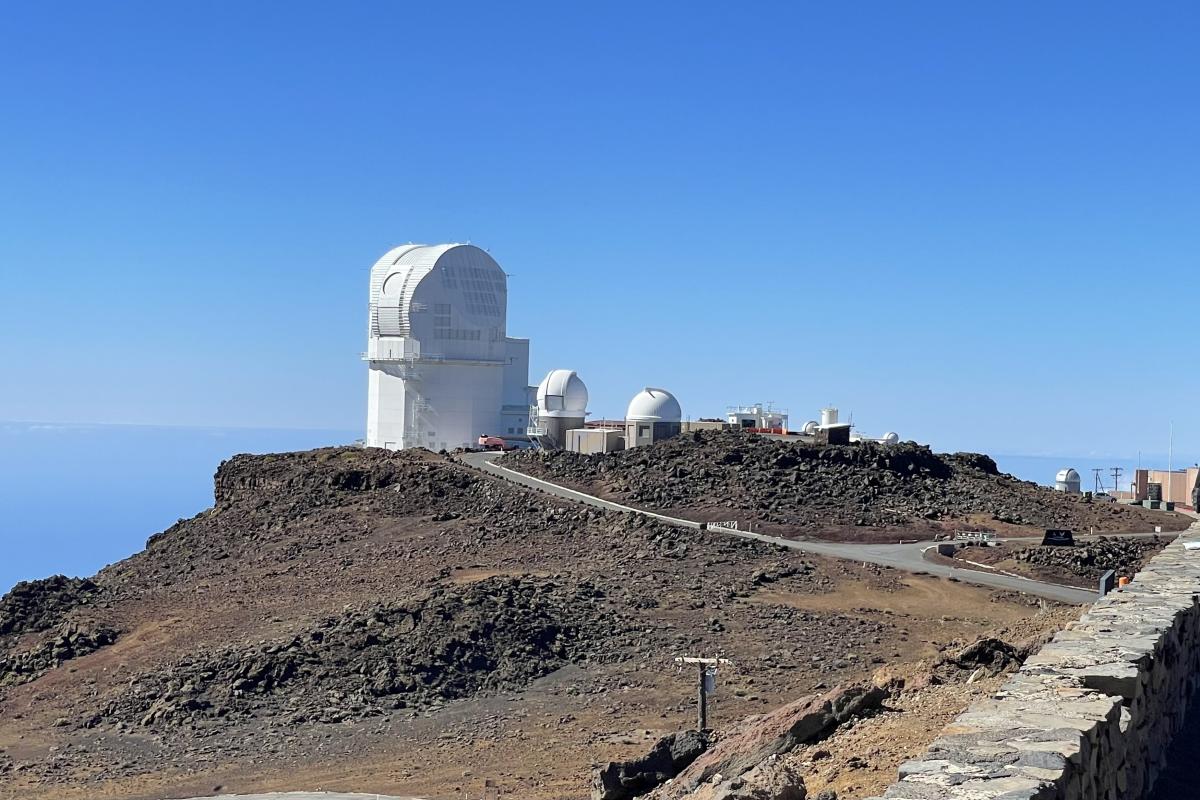
From Dunfermline to the Atacama Desert: Rotary Hears the Technology Behind Astronomy
Rotary members were treated to a fascinating journey spanning continents and decades when guest speaker Alistair Borrowman, a software engineer with Dunfermline-based Observatory Sciences Ltd, explained how a small local company plays a vital role in some of the world's most advanced astronomical research.
Alistair began not with telescopes, but with history - tracing the origins of his company back to what he affectionately called "the Battle of the Observatories." In the late twentieth century, the UK funded two separate astronomy technology centres: the Royal Greenwich Observatory and the Royal Observatory of Edinburgh. Both institutions had already relocated once before, moving away from city centres - Greenwich to Herstmonceux Castle in Sussex, and Edinburgh's observatory from Carlton Hill to Blackford Hill - after steam railway pollution began interfering with observations. Later, as astronomers sought clearer skies and higher altitudes, telescopes were moved further still, to La Palma in the Canary Islands and to Mauna Kea in Hawaii.
With the telescopes themselves no longer tied to any particular UK location, the government eventually decided that funding two separate technology centres was unnecessary. The Royal Greenwich Observatory closed, and its work consolidated at Blackford Hill in Edinburgh. Some Cambridge-based engineers relocated north, but others chose to stay - and it was this group who went on to found Observatory Sciences, the company Alistair now works for. Without that closure, he noted, his company likely wouldn't exist.
Today, Observatory Sciences is a software consultancy specialising in "Big Science" — research too large in scale for any single university to undertake alone. With offices in Dunfermline, Cambridge and Oxford, the company's main contract is with the European Southern Observatory (ESO), an international collaboration headquartered in Garching, near Munich. Despite its European membership, ESO's telescopes are situated entirely in the southern hemisphere, with its flagship site, the Paranal Observatory, located high in Chile's Atacama Desert — chosen for its dry air, altitude and clear skies.
Alistair shared striking details of the technology involved. Paranal's four telescopes each have an eight-metre primary mirror, and their light can be combined to achieve the resolving power of a single 200-metre telescope. He described how the observatory fires lasers into the night sky to create "artificial guide stars," which allow astronomers to correct for atmospheric turbulence using deformable mirrors that adjust a thousand times per second - effectively removing the twinkle of starlight to produce dramatically sharper images.
He also reflected on the scale of international cooperation such work demands. No single nation, he explained, can any longer afford to design, build and operate facilities of this size alone which is why the UK, which joined ESO only in the early 2000s, now contributes annually so that British scientists can access these world-leading facilities.
Members left with a new appreciation for the engineering, often unseen, that makes modern astronomy possible, and for the surprising Fife connection to a desert half a world away.
'What We Do' Main Pages:

Information and application form. Scroll down to see who has benefited from our grants programme.
more


Primary Schools linked to Rotary Club of West Fife:- Blairhall, Cairneyhill, Carnock, Crossford, Camdean, Culross, Inzievar, Holy Name, Limekilns, Milesmark, St Serfs, Saline, Torryburn, Tulliallan. Secondary Schools:- Queen Anne and Woodmill
moreOiling the West Fife Club's Rotary wheel
more

The club has a varied and interesting sports programme incorporated under the Entertainment Programme. .
more

Paul Harris Fellowship Awardees
more