Dunfermline’s Industrial Roots
Tue, Jul 14th 2026 at 6:30 pm - 8:30 pm
Guest speaker will be Peter Malcolm

Peter Malcolm's central argument is that Dunfermline's industrial history has been unfairly neglected by historians compared to cities like Dundee, despite the town's businesses being arguably more impressive and sophisticated.
The Dundee Comparison
Dundee's jute industry has been extensively documented by academic historians, but Malcolm argues Dundee actually did it "less well" than Dunfermline did linen. Jute required importing raw material from India, relied on low-value mass production (sandbags, tents), needed huge factories, and employed a heavily female, unbalanced workforce. Dunfermline's linen trade, by contrast, was high-value, technically difficult, and built on skill rather than sheer volume.
Dunfermline's Foundations
Before industry, Dunfermline's "staple industry" was religion and pilgrimage, built around St Margaret's shrine and the Abbey. The town's medieval layout persisted almost unchanged into the 20th century, divided into four quadrants, each home to a major linen works: the Bottle Works, St Leonard's Works, Albany Works, and the old Linen Quarter.
The Rise of Damask Linen
Fine Damask table linen arrived in Dunfermline in 1718 but remained a tiny, difficult craft for decades. Malcolm dates the town's real industrial breakthrough to 1851, the year of the Great Exhibition in London, where six Dunfermline firms exhibited and stunned visitors with their work. Only one of those six firms survived long-term, but the exhibition established Dunfermline's international reputation.
Key Families and Firms
Malcolm traces nine interlinked family firms, including:
- Erskine Beveridge – a draper turned manufacturer who built St Leonard's Works with perfect timing around the Great Exhibition, and became hugely influential.
- The Hunts and their factor James Matheson, whose family eventually took over the business.
- David Dewar and William Kinnis – technically brilliant operators who pioneered multi-shuttle, multi-colour weaving and sold linen worldwide, though the short-lived Dewar family couldn't sustain a multi-generational firm.
- Hay and Robertson, the Reid brothers (Pilmuir Works, 1849, credited with introducing steam power), and the Inglis family (Castleblair and Victoria Works).
He stresses these firms were essentially "prototype multinationals," expanding from small hand-loom operations to international businesses trading with America and the Empire within about 20 years, despite leaving almost no surviving business records.
Family, Marriage, and Civic Life
A recurring theme is intermarriage between these families, used as a deliberate strategy to keep firms within family control and pass ownership to multiple sons as company directors rather than splitting inheritance. Business owners lived close to their factories and workers, and treated civic duty (council seats, provostships, funding schools, hospitals, and the Carnegie Trust) as an extension of their business responsibilities. Robert Emery Walker, for example, personally bought Dunfermline's gasworks for the town, turning it into one of Britain's most profitable municipal utilities.
Decline and Diversification
By the early 20th century, family interest waned in later generations, and firms diversified or declined:
- Some factories switched to silk in the 1930s to beat tariffs Winston Churchill imposed on imported Swiss silk.
- Hay and Robertson moved into industrial fabrics and conveyor belting before being taken over.
- Pilmuir Works was bought by Dunlop in 1947.
- Henry Reid Stewart's rubber and bleaching business (Scottish Central Rubber Industries) diversified into hot water bottles, shoes, and waterproof coats, eventually failing in the late 1950s.
Conclusion
Malcolm closes by lamenting that, unlike Dundee's well-documented jute barons, Dunfermline's linen entrepreneurs have never had their business acumen, technical innovation, and civic contribution properly recorded — a gap he hopes his research will help address.
'What We Do' Main Pages:

Information and application form. Scroll down to see who has benefited from our grants programme.
more


Primary Schools linked to Rotary Club of West Fife:- Blairhall, Cairneyhill, Carnock, Crossford, Camdean, Culross, Inzievar, Holy Name, Limekilns, Milesmark, St Serfs, Saline, Torryburn, Tulliallan. Secondary Schools:- Queen Anne and Woodmill
moreOiling the West Fife Club's Rotary wheel
more

The club has a varied and interesting sports programme incorporated under the Entertainment Programme. .
more
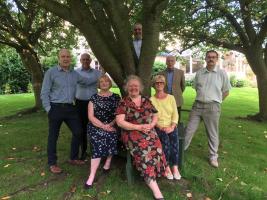

Paul Harris Fellowship Awardees
more