Defibrillator Project
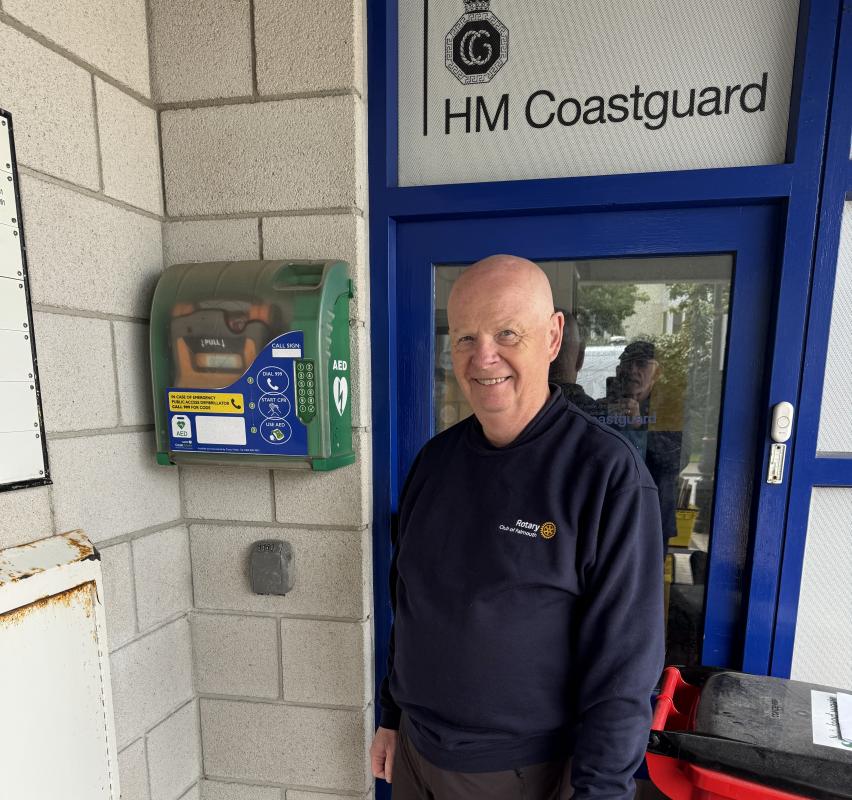
Falmouth Rotary has been working with Cornwall Ambulance Service to locate and check each defibrillator in the district.
Can Your Rotary Club Help?
Over the last few years, Rotary Clubs around Great Britain have been purchasing Defibrillators (AED) and donating them to community groups and others. But is that the end of the story?
A cardiac arrest is a situation where the heart stops and the casualty stops breathing. This is different to a heart attack where the patient suffers severe chest pain which could then later go into cardiac arrest.
The Rotary Club of Falmouth, has this year, had a bit of an awakening when it comes to the supply and support of these devices in our area.
At the beginning of the year, three of our members were very fortunate to attend a training session run by the Southwest Ambulance Services Trust (SWAST) and they subsequently asked for the same training at our Club. Meanwhile, we spoke with the SWAST Community Engagement and Training Officer, Andy Collins and asked if Rotary might be able to help SWAST in some way regarding AEDs in our area.
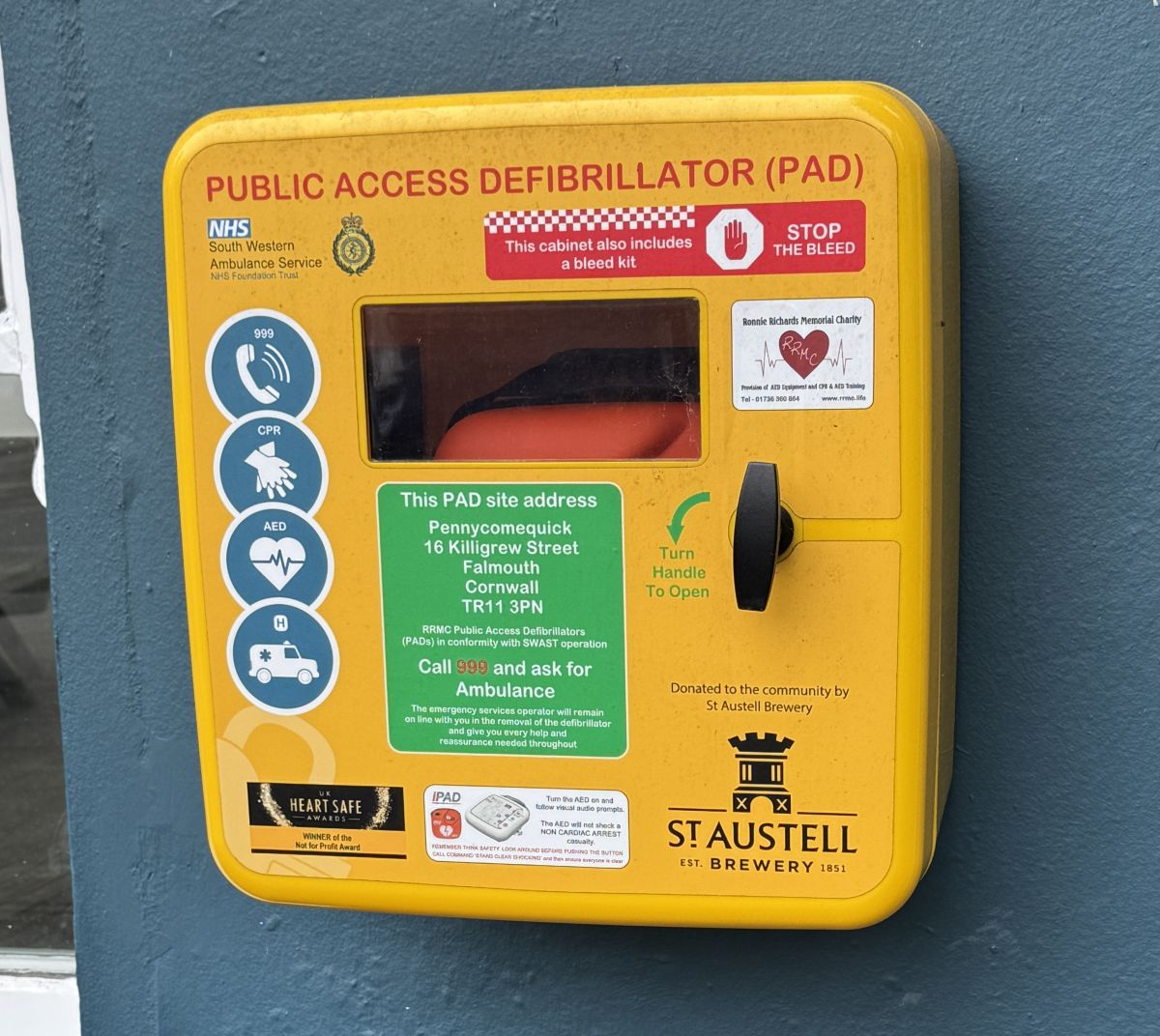
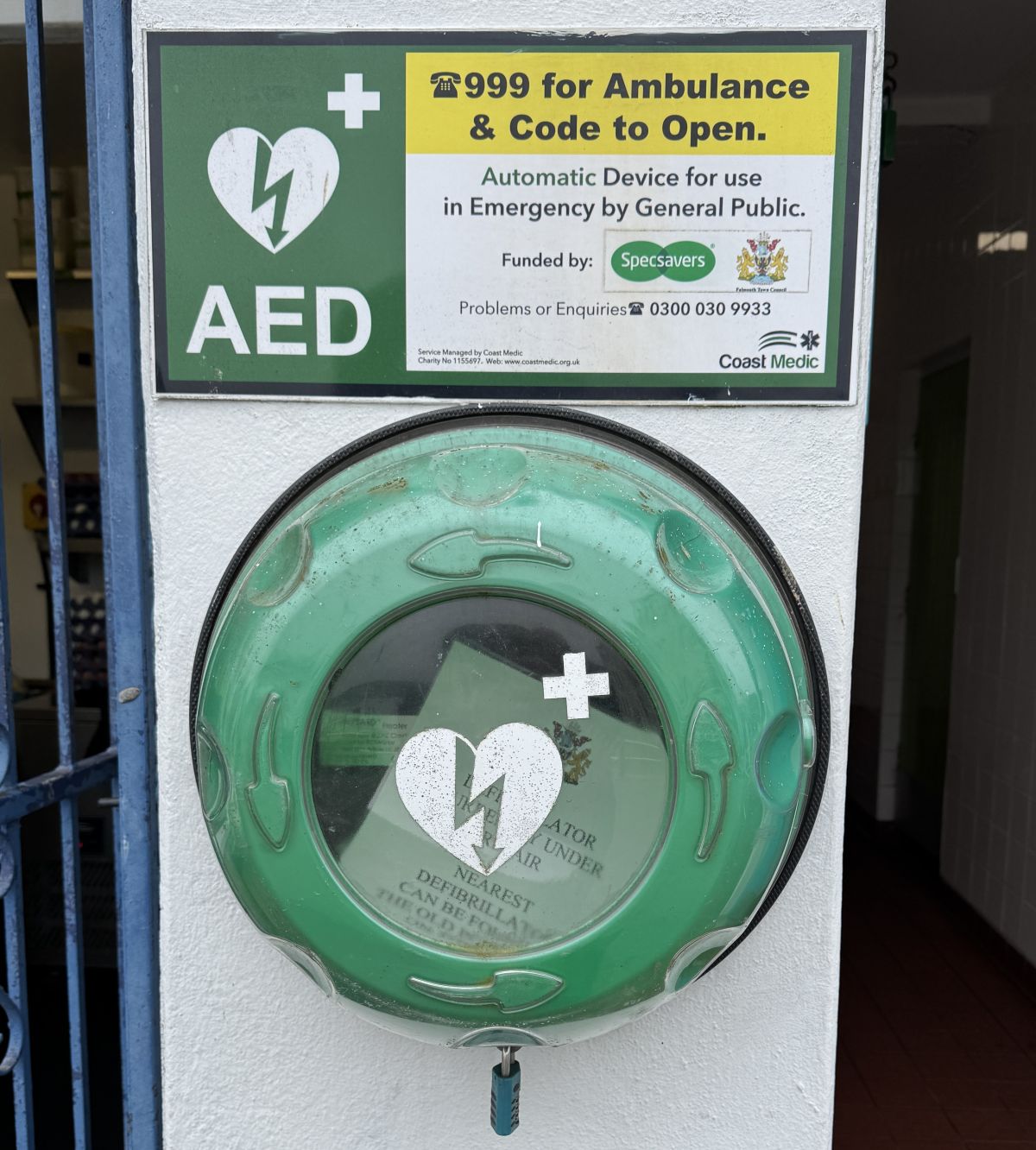
He asked us to find out the What3Words locations for all the AEDs in our area. We were amazed to discover that there are 78 AEDs in the Falmouth area. Some are owned by SWAST, some by primary and secondary schools and some by private organisations. We did as asked and provided the information requested to SWAST.
We then had a further discussion with Andy and he came to talk to the club one lunchtime about next steps. All AEDs need maintaining. There needs to be a monthly check on the condition of the AED and the contents of the box. The adhesive pads that are applied to the chest need to be replaced as soon as they have been used. Every 4 years or so, the battery in the AED needs to be replaced and the pads, if not used, have a use by date and need replacing when that date is past.
So, who does those monthly checks and resupply as needed? The term used by SWAST. and nationally by ambulance trusts and the British Heart Foundation, is “the Guardian” for that AED. Guardians are people who will carry out the checks as needed and cover the cost of replacement parts. Some Rotary Clubs may fund or be the Guardians, but other than supply of the AED, it is unlikely to be the case.
So, here are some “shocking” statistics for you!!
- In SWAST’s region, there are 13,784 AEDs of which 2,857 are not checked at all
- In Cornwall, alone, there are 1,837 available, of which 348 are not checked at all
- It costs between £100 - £300 per annum to maintain an AED, depending on the model. This covers pad and battery replacement.
- If an AED can be got to a casualty with cardiac arrest and used in conjunction with CPR within 3-5 minutes of their arrest, the chance of that casualty surviving the cardiac arrest improves by 50-70%
Inside the Cabinet are the following:
- AED box containing the pads and the device itself (with clear instructions printed on the inside of the lid)
- A pair of scissors, for cutting off clothing, as the pads must be applied to smooth, bare and dry skin
- A razor for removing body hair, if necessary (pads, do not stick well to hairy skin!)
- A towelette for drying off the area to which the pads will be applied.
So, how might Rotary Clubs help their local ambulance trusts?
This list is not definitive, and each Club or Region should speak with their trust before undertaking anything to do with AEDs
- Get training in CPR and the uses of AEDs (Your Ambulance Trust can help here)
- Go onto the DefibFinder website and find the registered AEDs in your area
- Go and look for each one and make a note of its condition (without opening the cabinet) and its What3Words Location.
- Help your Ambulance Trust to educate local community groups in how to use AEDs
The British Heart Foundation has set up a website to enable the public to find their top 5 to 10 nearest AEDs to their immediate location and this is called the Circuit (defibfinder.uk)
There may be other things your club can do to help your Ambulance Trust, but that is a start and in addition, none of this will cost your club anything but your members’ time in the community!
Note to the Editor: David Stewart is a member of the Rotary Club of Falmouth. Southwest Ambulance Services Trust and the British Heart Foundation’s The Circuit Team are aware of this article, and both support this activity.
Contact David Stewart about this page:
Related pages...
STEM in Schools
more STEM stands for Science, Technology, Engineering and Mathematics. Falmouth Rotary are supporting the advancement of these subjects in local schools.

Miscellanous Activities
more Falmouth Rotarians participate in many community days such as Remembrance Day, Armed Forces Day, Tall Ships, Celebrations and Commemorations, as well as supporting other groups.

Age UK
more Falmouth Rotary volunteer twice a year at the Age UK fetes which helps to raise money for the charity.

Surgical Robot for Treliske Hospital
more Falmouth Rotary is coordinating efforts to raise funds for a surgical robot for Treliske Hospital.

Litter Picking
more Litter Picking sessions have been organised at specific sites around Falmouth. The aim is to have a litter pick in a different place around Falmouth each month.

Christmas Float
more Every year Falmouth Rotary organise a musical festive float to collect for local charities.

Know Your Blood Pressure (KYBP) Day
more Even though we no longer offer this service, Falmouth Rotary held a walk in test for over 13 years.
back to page above this...
Community Involvement
back The Rotary Club of Falmouth participates in the community in a number of different ways. Whether it be volunteering to support local events, litter picking, or manning the collection tins for Charity at Christmas, we strive to help out in our local area.