The Nature of Reality
Thu, Apr 9th 2026 at 7:00 pm - 9:00 pm
Bill Lockley presents
Club members please log in for more information.
09/04/26-What is reality? – Professor Bill Lockley
Bill started with an interaction by asking our members to close their eyes and cover their ears for 10 seconds. Then asking “what do you see, hear and feel? Can you feel your seat, your tongue, etc” and commenting that “What you are experiencing is Reality and that is what this talk will be about?
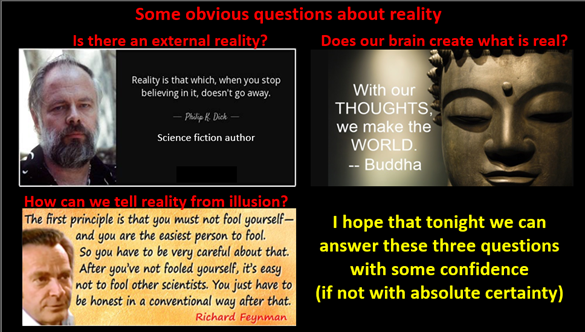
Then followed three questions which the presentation aimed to answer 1/ Is there an external reality (reality is that which, when you stop believing in it, doesn’t go away, Philip K Dick) 2/ Do our brains create what is real?” (With our thoughts we make the World – Buddha). 3/ Can we tell reality from illusion (The main point is not to fool yourself and you are the easiest person to fool, Richard Feynman)
He then showed that the words we use to talk about reality can be grouped under two headings Ontology (What exists) and Epistemology (How do we know about it). Examples were given of existence before humanity evolved (the discovery of minor planet Arrokoth) and of how different species, chimps, ravens and our own species try to understand (i.e model) a real object (a tree).
It was pointed out that the philosophy being explained was Scientific Realism, but that other idealistic philosophies existed as alternative ways to see the world, examples where the ideas of Plato (the world of forms), Max Tegmark (the realm of absolute mathematics) and St. Paul (God, Heaven & Hell). Although Idealist philosophy often underlies many superstitions and religions it is not restricted to them. One idealist philosophy, Hard Solipsism, was briefly examined and shown to be unfalsifiable and in Bill’s estimation, immensely egotistical.
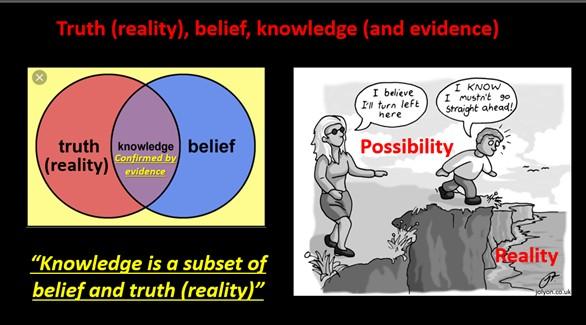
Next, the difference between knowledge and belief was demonstrated. A cartoon illustration with two people walking towards a cliff edge, one blind person who believed it might be best to turn left based on her limited hearing of the waves and the other sighted person who knew he should not go straight on. The difference in the information they each had illustrated the difference in the degree and quality of evidence needed for knowledge rather than simple belief. A Venn diagram was then used to show that knowledge was a sub-set of both belief land truth about reality. We believe many more things than we know and we know fewer things than are out there in reality. Our knowledge is therefore a subset of both truth(reality) and of belief. Knowledge is therefore defined as belief which is justified and confirmed by evidence.
The function of the brain is to keep you alive, but the brain can only rely on its sense connections, so the ‘reality’ the brain constructs becomes an informed guess based on its sense inputs and its previous knowledge. Several examples were shown of how the brain makes its guesses and how it can often be fooled by optical illusions (and auditory illusions too (look up Green-needle/brainstorm on Google). Examples included an upside-down picture of ‘Adele’, which when inverted looked nothing like Adele! A picture of a dress next that appeared blue and black to some members, but gold and white to others, all influenced by whether the observer judged the light to be sunlight or not (the brain subtracts blue from sunlight).
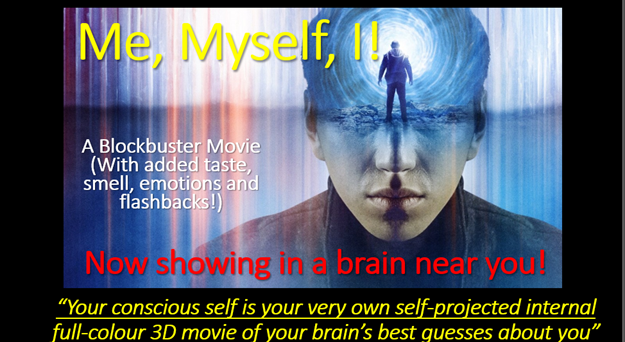
He then asked “what do we know about the self?” and answered that when the brain integrated all its inputs (from the external world and from the body, with all its wants and feelings the result was a full colour real-time blockbuster movie with added taste, smell, feeling and flashbacks’ The me, myself and I, in fact was the brains best guess of all that was coming in from its inputs filtered through all its previous experience and given a first-person interpretation.
That sometimes the brain gets it wrong was illustrated by a personal ghost story with an explanation of how the brain misinterpreted its incoming information in an information-poor (dark) setting.
What do we mean by ‘real’, what is a ‘thing’? It seems that a “thing” is a pattern of properties in nature which has some persistence on the timescale we are describing it on.
After outlining why the subjectivity of the brain was a problem for investigating “what is real” Bill outlined the Scientific Method using an example of how to use it to determine the shape of the Earth via hypothesis testing and elaboration of scientific theories. He then went on to explain what our use of the Scientific Method had revealed about what is real over the last 400 or so years. We now know that at the most basic level the Universe is made of ‘Quantum fields’, which are things which that have a value at every point in space. There are many of these fields and they interact with each other. The only ones we can sense as humans are the electric, magnetic and gravitational fields, but there are many others including the strong and weak nuclear force fields which pull atomic nuclei together and are responsible for radioactivity. But asked Bill, “what about ‘particles and waves? He showed that these were excitations in the fields and were responsible. In sequence, for building protons and neutrons, atomic nuclei, atoms, molecules, materials, and ultimately, the whole world including ourselves.
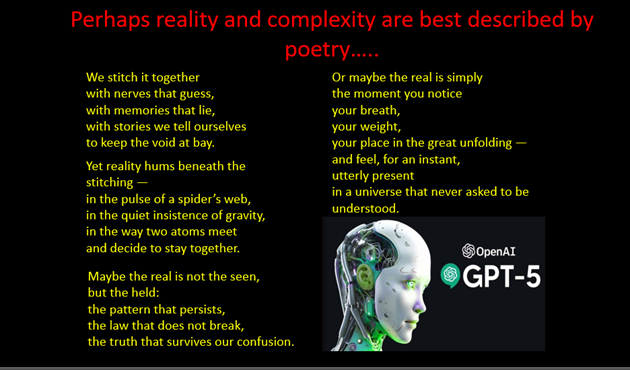
How about bigger things? These result from the phenomenon of Emergence. This he illustrated with a video of a murmuration of starlings, where each bird operates within specific rules leading to new properties for the whole murmuration which no individual bird possessed. His final slide was a demonstration of emergence…AI in action with a poem from GPT-5 about reality. This demonstrated the power of emergence when billions of computer neural networks collaborate according to simple rules.
Questions followed regarding the physics of multiple dimensions (string theory), what is ‘beyond beyond (the next layers of reality) and time travel (relativity, paradoxes and closed time-like loops), all explained by Bill, answered proficiently and openly.
Gordon gave the Vote of Thanks suggesting that he was anxious about doing a ‘thank you’ to a professor, but then posing the question “is tonight real?”, referring back to the ‘ghost story’, adding that he’d found it a fascinating talk, not sure he had understood it all, commenting that it was well received by our members as indicated by the number of questions. AR
'What We Do' Main Pages:
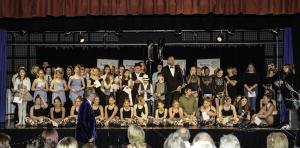
We have now successfully run this event for 10 years. Full reports of each year are available under this main page
more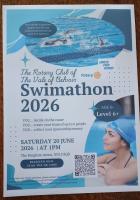
It's here that you can read what we've been up to in the last few months. For more information on our work in the local community, with our young people and internationally please access "what we do" section of this web site.
more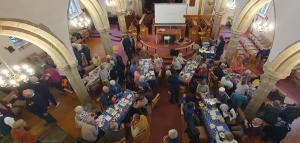
This is a monthly meeting open to visitors from Bingham, Radcliffe, Cotgrave and all villages in surrounding area.
moreThis committee are involved in planning now we can raise funds for our chosen charities
more
If you like what we do as an organisation and are interested in volunteering with us, keeping up to date with our plans and future events then why not consider signing up as a friend of our Rotary Club
more
Our International Committee is involved with Polio Plus - a Rotary initiative to eradicate Polio, World-wide; Sand dams; Aqua Boxes; Shelter Boxes; Collecting used spectacles, and many other projects
moreHere you can read about the many meetings we've had during our formation as a Rotary Club. The early years are a little short on detail...
more