Abingdon Rotary helping Africans in Mubende, Uganda
Abingdon Rotarians Maya and Paul Smeulders have led a project to help rural Ugandans for many years. Read on to find out more...
An enduring love affair with the people of Mubende, Uganda
It was love at first sight when in 1997 a group of Abingdon (UK) Rotarians visited Mubende to give farm tools to women's groups. Other projects followed and these developed into a multi-faceted program that includes agricultural microcredit, fuel saving cookstoves, goat breeding and support for village primary schools. Altogether, it can tick the boxes of 16 out of 17 UN Sustainable Development Goals.
Background
Mubende is a rural area where subsistence farmers live in villages without electricity, running water and public transport. Schools are insufficient, healthcare is poor and agriculture is done by hand. Despite all that the people are welcoming and ready to share a laugh.
Agricultural Microcredit
The agricultural microcredit scheme started in 2007 with just three farmer groups. This number gradually increased to 40 microcredit groups at any one time and a total of 170 groups to date. The philosophy behind the project is to give a hand-up, not a hand-out. Our team of Key Farmer Trainers will help a group to set up a saving and lending scheme and give training in organic agriculture and book-keeping. They are young farmers, who after receiving free training at an Organic Agricultural College, have committed themselves to sharing their knowledge with farmers and schools in their communities.
Once a group has sufficient practice in saving and lending, it will receive a three-year interest free microcredit loan, which it will self-administer. There are of course rules and guidelines and it is important that they are followed, as they are designed to lead to success. During this time the KFT continues to mentor the group. Rotarians will also visit every year to give encouragement and to make sure that all is going well.
Loans to individual members are collectively decided by the group and can only be for an income generating project. The interest rate is affordable and a four-month grace period allows crops to grow or an animal to be raised before the first payment is due. At the end of three years the whole group is responsible for paying back the original loan, but the interest stays with the group and is added to its loan pool. This enables the group to continue. The money that comes back is then passed on to another group. Thus, the microfinance fund is being recycled again and again.
This scheme has enabled thousands of farmers and tens of thousands of family members to have a better lifestyle and hope for the future. It has paid for children’s education, home and farm improvements and other benefits. The participants have learned to plan as well as agricultural knowledge and leadership skills. The key to success is perseverance and patience. Fairness and transparency are also vital ingredients of the magic formula.
Farmers face many challenges, some of them climate related, others due to lack of knowledge and investment. Ordinary bank loans do not address the needs of subsistence farmers, the simple microcredit scheme does.One group-leader told us “Microcredit has helped us a lot. Those with bicycles, now have motorbikes. Those without land, now own a plot. Those with a mud house, now have a permanent home. Those without animals, now own a cow.”
Fuel-saving mud-stoves
Working with the groups, we became aware that women and children were spending up to five hours a day collecting firewood for cooking and used open fires that filled their kitchen with toxic smoke and caused burns. Something needed to be done, urgently!
We learned about a fuel-saving mud-stove that is made from natural local materials, saves two-thirds of firewood and takes the cooking smoke out of the kitchen. Ideal for the situation, as they fit with the local culture. It brings enormous health benefits and frees up a lot of time for other things. With a bit of training and effort, people can make their own stove without needing any money. This is now part of the groups' training program. The women love them and they are literally dirt cheap...!
Bigger mud-stoves have also been installed in 130 schools that cook school meals for 60,000 pupils. Instead of using three lorryloads of firewood per term, they now only use one. The money saved is better spent on education.
It is also a big win for the environment by reducing CO2 and black carbon emissions. When combined with planting a small number of trees every year a mud-stove is a net-zero way of cooking. Thousands of families now use mud-stoves in Mubende and in other parts of Uganda where we were able to train local Trainers.
Learning 4 Life School Development Programme
While visiting groups, we also saw the problems facing rural primary schools: crumbling buildings, overcrowded classrooms, demoralised teachers, lack of teaching aids, and often hungry pupils.
Sometimes there is no public school at all and parents, often illiterate themselves, try their best to organise a community school.
Again, something needed to be done! In 2015 we set up a charity called "Stichting Learning 4 Life" L4L to grow food for school meals around the schools, improve school buildings, harvest rainwater, provide teacher training and teaching aids. To liven up the school day, there are also libraries, quizzes, music, dance and sports. L4L aims for a positive learning environment where beating has been abolished.
As a result, school enrolment and attendance in L4L schools has increased a lot, in some cases it doubled or even tripled. Dropping out rates have diminished and Primary Leaving Exam results have improved.
Over a period of ten years generous donations from a Dutch Education Foundation have enabled L4L to make lots of improvements, but this has now come to an end and we are looking for alternative funding.
Good education is the best gift we can give to children. In Uganda today, land has become scarce and youth unemployment is high. It is more important than ever, that rural boys and girls get basicprimary school education and additional skills, so that they can adapt to whatever future they may face in later life.
For pictures and further information please see our website https://learning4lifeafrica.org/ and https://learning-4-life.nl
Rtn Maya and Paul Smeulders
mayasmeulders@hotmail.com
 Contact Maya Smeulders about this page:
'What We Do' Main Pages:

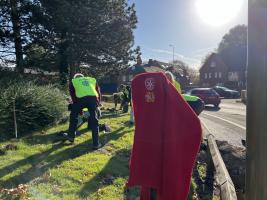
4000 crocuses planted outside Abingdon Police Station in two hours to celebrate our Rotary Foundation ending Polio across the world
more
One of the most popular events on our calendar, the regular DNAPQuizzes raise a lot of money for our local charities, supported by the Rotary Club of Abingdon.
more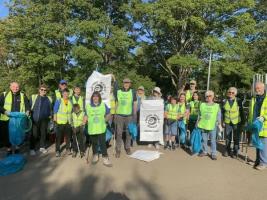
Recently we joined other groups in Abingdon on a River Litter Pick. The sun shone and we all had a great time. We look forward to being involved with the Plastic Blitz next time.
moreAbingdon Rotarians Maya and Paul Smeulders have led a project to help rural Ugandans for many years. Read on to find out more...
more
Two splendid cups commissioned for our Club's annual Youth Speaks competition. Often won by our talented young people from Abingdon's secondary schools, our winning teams often go on to the next levels of this national Rotary Competition!
more
The Club's foreign conscience - here immunising under-fives in India against Polio. There is no cure for Polio but it is preventable with a vaccine. Only two countries now remain endemic. We’ve reduced cases by 99.9% since 1988
more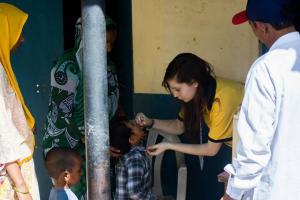
The Rotary Foundation is Rotary International's own charity. It does an enormous amount of good in the world. Watch the video The Heart of Rotary for a flavour!
more