Rotary and International Charities
From Horwich to the front line: the Rotary roots of a global aid mission
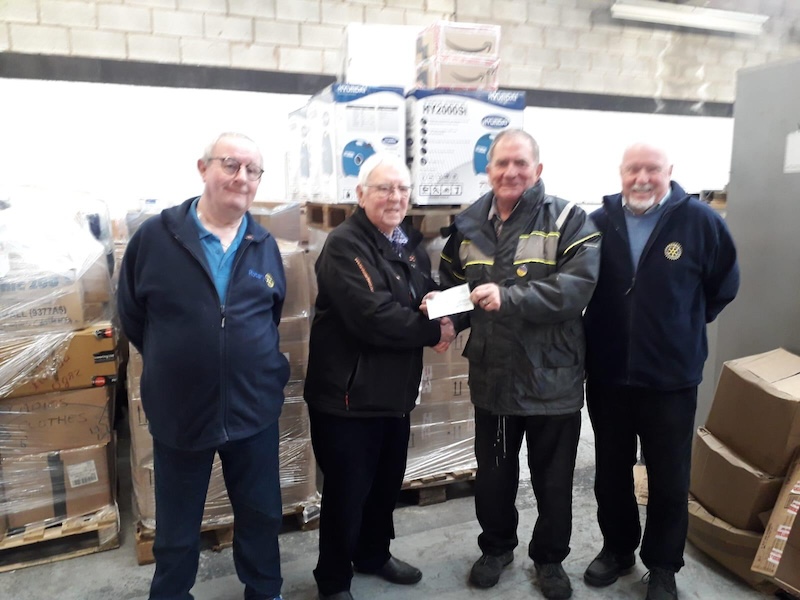
Through the charity run by Horwich Rotarian, Revd. Bernard Crocker, the club has been playing its part in alleviating the suffering in Ukraine.
Standfirst:
Meet Rev Bernard Cocker, a Rotarian from Horwich in Greater Manchester, whose response to suffering in Eastern Europe sparked the creation of an international charity which has delivered humanitarian aid for more than 35 years
The first images stayed with him: hospitals, orphanages, children in need.
For Rev Bernard Cocker, a visit to the former Soviet Union in 1991 did not end when he returned to Lancashire. It became the beginning of something far more enduring: a humanitarian operation which, 35 years on, continues to deliver aid into some of the most challenging environments in the world.
The organisation he founded, the International Aid Trust, has grown from those early encounters into what is now one of Europe’s longest-established charities working in Ukraine.
“We began in 1991 after my first visit when I saw images of pain and suffering, that would never leave me, especially in the hospitals and orphanages,” he recalled.
“I fell in love with Ukraine and its people, and I returned to the UK with a dream, a vision to make a difference. We began collecting and sending lorries of humanitarian aid.
“We opened our first charity shop in Clayton Brook near Chorley in 1991, this was soon followed by our next shop on Pall Mall, Chorley, others soon followed.
Building something that lasts
One of the first things the Trust did was to set up children’s holiday camps in Odesa, Poltova, Balaclava in the Crimea.
In 1993, the charity built its first centre for children in Myakie near Odesa. It was opened by Sir Roy Reeve, then the British Ambassador to Ukraine. Since then, hundreds of thousands of children have been given free Christian holidays. It has also built a rehabilitation centre near Kyiv.
What distinguishes International Aid Trust is not simply its longevity, but its continuity.
From the outset, the charity invested in relationships on the ground. In Ukraine, the same leadership teams that began working with Bernard more than three decades ago are still in place today - now joined by second and third generations.
“We have the same leaders in Ukraine that we began with 35 years ago,” he said. “Their children, and now the third generation, are working with us.
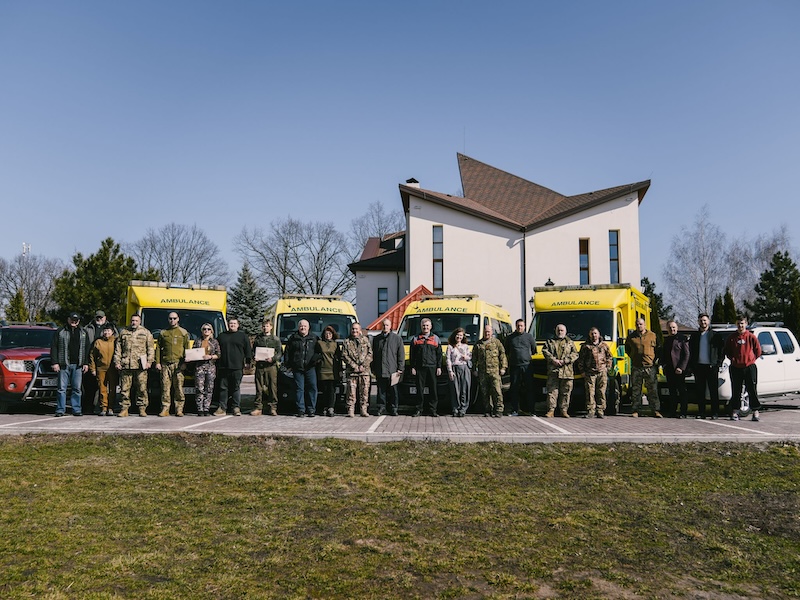
“We work with hospitals, orphanages, churches, clinics and the military. We have provided mine detectors sponsored by Rotary clubs, along with ambulances sponsored by Rotary.”
Over time, its work has expanded across multiple fronts: healthcare support, rehabilitation centres near Kyiv, prison ministry, education programmes and children’s homes.
Further afield, in Sierra Leone, the Trust now runs schools serving more than 700 children, providing not only education but daily meals and care in communities facing extreme poverty.
Responding when it matters most
If the early years of International Aid Trust were defined by building foundations, the past four years have tested those foundations under extreme pressure.
When Russia launched its full-scale invasion of Ukraine in February 2022, the charity was already embedded in the country. That presence proved critical.
“International Aid Trust was uniquely positioned to respond quickly due to its long-standing presence, strong local networks, and dedicated Ukrainian team,” notes the organisation on its website.
The scale of the response has been significant. Since the war began, the Trust has sent 98 articulated lorries carrying more than 1,200 tonnes of aid, valued at over £23 million. Alongside this, dozens of ambulances and evacuation vehicles have been delivered to frontline areas.
But the response has not been limited to logistics. Through partnerships with Ukrainian churches, the Trust has also provided pastoral care, while continuing its long-running children’s camps, offering respite to more than 2,000 children affected by conflict in 2025 alone.
Rotary at the heart of the effort
The story of International Aid Trust is also a story of partnership. Bernard has been a Rotarian since 1992, a member of Horwich Rotary Club, and a Paul Harris Fellow. From the beginning, Rotary has been embedded in the charity’s work.
“There is hardly a single project of ours that Rotary has not been involved in,” Bernard insisted.
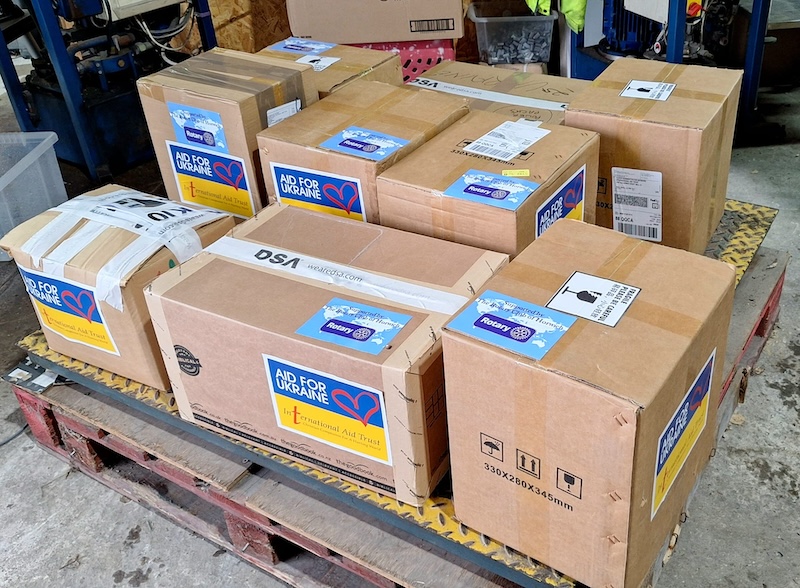
That involvement has taken many forms: funding ambulances and generators, supporting shoebox appeals, organising collections, and even driving aid convoys into Ukraine.
Rotary clubs such as Horwich, Preston South and Clitheroe have played key roles, while others across the UK have contributed equipment ranging from mine detectors to medical supplies.
Bernard is clear about the significance of that support. “Rotary has been an extraordinary partner in our work. The practical compassion, generosity, and hands-on involvement of Rotary clubs has quite literally saved lives.”
A place within Rotary’s humanitarian landscape
Rotary has long been associated with major humanitarian initiatives: from global programmes such as End Polio Now to operational charities like ShelterBox and Aquabox. Within that landscape, International Aid Trust occupies a distinctive position.
Whereas organisations such as ShelterBox specialise in rapid-response disaster relief, and Aquabox focuses on clean water provision, International Aid Trust operates across both emergency response and long-term development.
Its model is less about a single intervention and more about continuity. It returns to the same communities year after year, building infrastructure, relationships and trust. The International Aid Trust is also notable for its faith-based approach, working through churches and Christian partners while delivering practical aid. That combination of spiritual and material support is central to its identity.
At the same time, its close alignment with Rotary - both through its founder and its network of supporters - places it firmly within the wider Rotary family of service organisations. In practical terms, it often acts as a conduit: enabling Rotary clubs to channel resources, expertise and manpower into sustained international projects.
The importance of infrastructure
Behind the headline figures of lorries, ambulances and tonnage of aid sits a less visible but equally important element: infrastructure. International Aid Trust is funded in part through a network of charity shops across the UK, ensuring that donations are converted into consistent income streams.
Its warehouse operations have also played a crucial role. Before relocating during the Covid-19 pandemic, the Trust stored and transported large volumes of Rotary shoebox donations, alongside its own longstanding shoebox appeal.
These operational details matter. In humanitarian work, the ability to store, sort and transport aid efficiently can determine whether assistance arrives in time - or not at all.
For all its scale, International Aid Trust remains rooted in the experience that inspired it.
Bernard’s early visits to Ukraine shaped not only the organisation’s direction, but its ethos: one of personal connection, long-term commitment and practical action.
He has gone on to deepen that connection in ways few charity founders do, including being ordained in Ukraine and becoming a member of its National Guard.
As the war in Ukraine continues, and as global humanitarian needs grow, the role of organisations like International Aid Trust is unlikely to diminish.
Its strength lies not in scale alone, but in its consistency - in returning, year after year, to the same places, the same partners, the same mission.
Website: www.internationalaidtrust.org.uk
Many thanks to Julie Rowlandson from International Aid Trust for writing the. article which will appear in the national Rotary Magazine.
Rotary and International Charities sub-pages:
Rotarian Derek Snowden's humanitarian voyage to Ukraine
more Our newest Rotarian, Derek Snowden provides a few words and images of the journey he took when Mayor of Blackrod with essential items to the Ukraine.
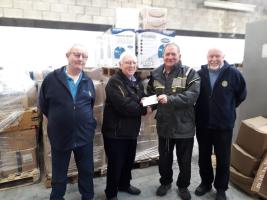
Funding generators for Ukraine
more In 2023 Horwich Rotary funded six generators to help Ukrainians charge essential devices