Stitching Opportunity: The Sanitary Towel Project in Kenya
What began as an unexpected connection in the foothills of Mount Kenya has grown into a practical, hopeful project helping girls stay in school, learn new skills, and support their communities.
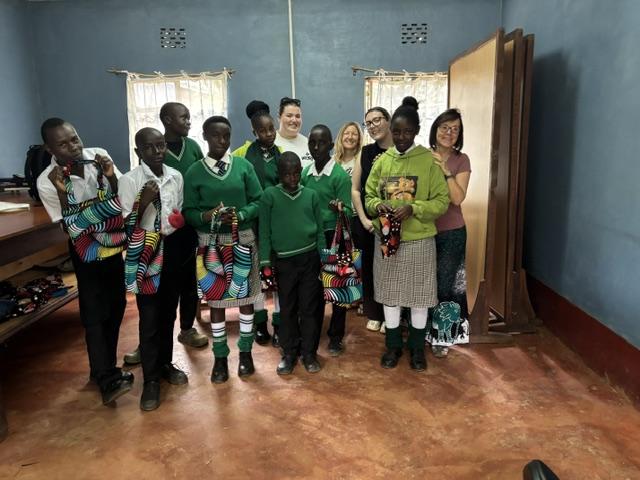
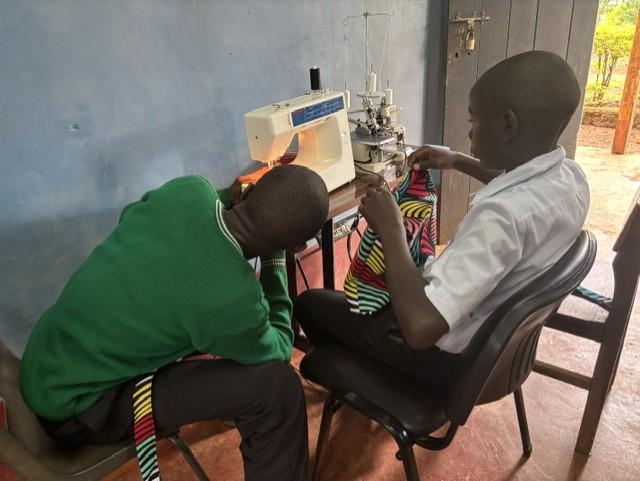
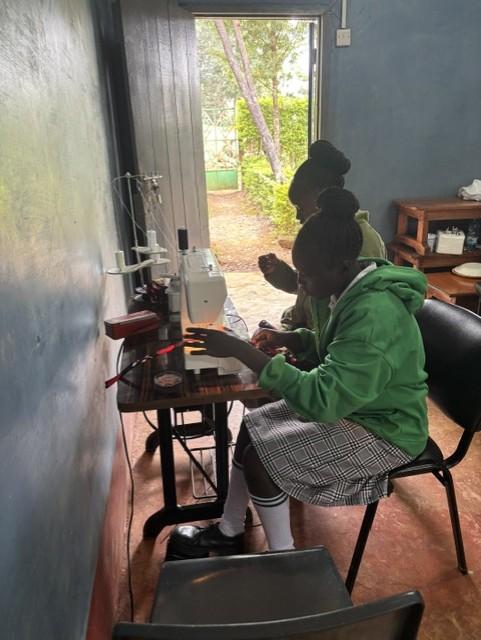
Rotarian, Julie Fry, shares her experiences of her volunteer work in Kenya, focused on supporting young women.
A project that grew from a chance conversation
In December 2016, Martyn Hastings spoke to Casterbridge Rotary about the Sanitary Towel Project he had started in the foothills of Mount Kenya. Like many worthwhile projects, it was not something Martyn set out to create. It evolved from relationships, practical help, and a willingness to listen.
Martyn had worked with the British Army, taking soldiers to climb Mount Kenya. On one trip, he got talking to a man in a bar who turned out to be one of the local Chiefs. Martyn asked about the area's aspirations. The answer was a health centre where local people could receive free local healthcare.
Martyn agreed to ask the soldiers to help dig footings and carry out other work when they next visited. That was the beginning of the link with the area. Even after his connection with the Army ended, he continued to take groups of volunteers, students, and scouts to undertake voluntary work there.
Les had been giving Martyn recycled IT equipment for many years, and I had known Martyn when I worked at Came Down Golf Club. At the end of the Rotary presentation, Martyn asked Les whether we would like to join him on his next trip to Kenya in February 2017. We intended to go once and tick it off the bucket list.
It is difficult to explain exactly what it is like to live and work with a Kenyan family in their community. If you have the opportunity to go to Africa, I would urge you to take it—not as a tourist, but by getting down and dirty and doing voluntary work. You may leave Africa, but Africa will never leave you.
|
“You may leave Africa, but Africa will never leave you.” |
Discovering period poverty—and its wider cost
On that first trip, we visited several schools. At one, all the children's results were displayed on a wall. At the very bottom, the figures stated: Boys' attendance 89%; girls' attendance 60%.
We asked why there was such a large discrepancy. The answer was given in a very matter-of-fact way: girls did not attend school during their period weeks because they did not have sanitary provision. Education is a fundamental right, not a privilege. It was deeply saddening to see it denied because of a lack of sanitary pads.
School attendance was also linked to food. All children are fed at school in Kenya. The youngest receive a cup of porridge mid-morning, and all children receive a bowl of beans, maize, or rice at lunchtime. It may not be delicious, but it is substantial and nourishing food.
For many of the poorest children, school food is their only meal of the day because their families are too poor to keep food supplies at home. A girl who missed school because she lacked sanitary provision could therefore miss a week of nutrition as well as a week of education.
One of the other women on the trip was Meryl Turner, a Health Visitor from Dorchester. We had many conversations during the trip and after we returned about what we could do to ease the situation.
Designing a kit for everyday use
The World Health Organization had a pattern for washable sanitary towels on its website. The pattern was large and bulky and suggested using a very expensive waterproof fabric. I adapted it, making it suitable for girls and using recycled fabric wherever possible.
The 2018 distribution and school demonstrations
When we returned in 2018, we had enough supplies for 64 girls. Each girl received a drawstring bag to keep everything safe when it was not being used. Every kit contained:
- 9 washable sanitary towels
- 5 pairs of pants
- A body soap and clothes-washing soap
- A small bag for taking a clean towel to school and bringing a soiled one home
At each school, Meryl gave a health and hygiene talk, while I gave a practical demonstration on how to wear the sanitary towels. I dread to think how many photographs there are of me prancing around Kenyan classrooms with knickers on the outside of my trousers.
After distributing the 64 bags, we returned home to the UK and I started sewing again. At that time, there was no Wi-Fi connection with the schools, so we had no idea whether the pads were being used.
2019: seeing the difference
Our return in 2019 was accompanied by some trepidation. We had prepared more bags, but we did not know whether the ones distributed the previous year were being used or had simply been thrown away.
We were delighted to hear from both the girls and the schools that the kits had made a huge difference. The girls were attending school more regularly. The practical support was helping them remain connected to both education and the school meals they relied on.
|
A lasting measure of impact The clearest encouragement came from the girls and schools themselves: the reusable kits were being used, and girls were attending school more regularly. |
2020: sharing the skill of sewing
In 2020, I spent much of the trip teaching some women to sew and setting them up in a little kiosk shop where they could make and sell sanitary towels. All was going well, but during the trip we heard that England had recorded its first Covid-19 case.
Within a few weeks, the UK went into lockdown, and Covid-19 hit Kenya a little while later. Unfortunately, the momentum was lost.
Continuing after Martyn's death
Sadly, Martyn Hastings died while we were in lockdown, and the future of the project was in doubt. His widow, Josie, and his son, Dan, took over running the group and set it up as a registered charity.
They continued taking volunteer groups each February, while concentrating on the child sponsorship element of the work rather than the large building projects Martyn had liked to undertake. The Sanitary Towel Project is slightly separate from the main project work, and it has continued at pace.
From the next bag to the thousandth
By the time we go in 2027, we will be approaching our 1,000th bag distributed. We now see girls who received supplies a few years ago completing their local education, going to university, or getting good jobs in the local area. Their progress is helping improve the communities in which they live.
Their education has improved, and their nutrition has improved. A further idea has also been associated with girls wearing underwear: that they may be less likely to be raped because they are perceived to be affluent. This was reported in an Inner Wheel article in 2016, but the idea has been disputed more recently and should not be presented as an established fact.
Learning, making, and repairing in 2026
During my 2026 visit, I spent time teaching 24 young people to sew. Sewing had been added to their curriculum in January 2026, but the Government had not yet supplied most schools with teachers.
The children were keen to learn a new skill. They made some amazing bags and wallets to hone their abilities. We also held a repair-shop day, when the young people brought items from home that needed fixing. It was a practical way to show them how useful their new skills could be.
On the final day, I worked with the girls alone, teaching them how to make sanitary towels. The sessions connected creativity with independence and showed how sewing can answer a real need.
Looking ahead: teaching teachers
Moving forward, I would like to teach more Kenyans to make reusable pads so they can supply their own needs. I aim to teach the teachers in 2027, in the hope that all schools will then have a sewing teacher in place. If that happens, my work will be complete.
Recognition in the King's first New Year's Honours List
I was honoured to be awarded the British Empire Medal in December 2023 in the King's first New Year's Honours List, for my work towards health and education in Kenya.
It was an amazing honour, made especially meaningful because it was supported by some of the Head Teachers in Kenya. They outlined the huge difference the washable sanitary towels had made to the girls' attainment.
The people behind the project
Meryl and I know that none of this would be possible without the help and support of so many people. That includes everyone who has helped sew sanitary towels and bags; people from DCH and Rock Choir who donated huge amounts of girls' pants; and those who donated sheets and towels to go into the construction of the pads.
It also includes the schools, teachers, children, families, volunteers, and local communities who have made the work meaningful and practical. And we must not forget my long-suffering husband.
The project began with a conversation, grew through many hands, and continues because people keep sharing their time, skills, materials, and hope. Its future lies not only in distributing reusable pads, but in making sure that the knowledge to create and repair them remains in the communities that need them.
|
Dr James Kwegyir Aggrey is widely attributed with the saying: “Educating a boy benefits the individual while educating a girl transforms the entire household and future generations” |
Contact Julie Fry about this page:
'What We Do' Main Pages:
Family completed the Rome Marathon, including pp Mark Parker for the new Accident and critical care unit.
more
What began as an unexpected connection in the foothills of Mount Kenya has grown into a practical, hopeful project helping girls stay in school, learn new skills, and support their communities.
more

Young Artist Competition 25/26 in collaboration with Casterbridge Rotary - Theme Happiness in Nature
more
Raising funds for the new A&E and CC for additional equipment to help patients, visitors and staff.
more