Lighting Lives in Sierra Leone
Fri, Nov 13th 2026 at 9:34 am- Thu, Dec 31st 2026 - 11:34 am
Doctor Helen Clayton gave a presentation on her medical outreach work in Sierra Leone with the Transform Salone Charity, including its project to provide solar light to some of the country's villages.
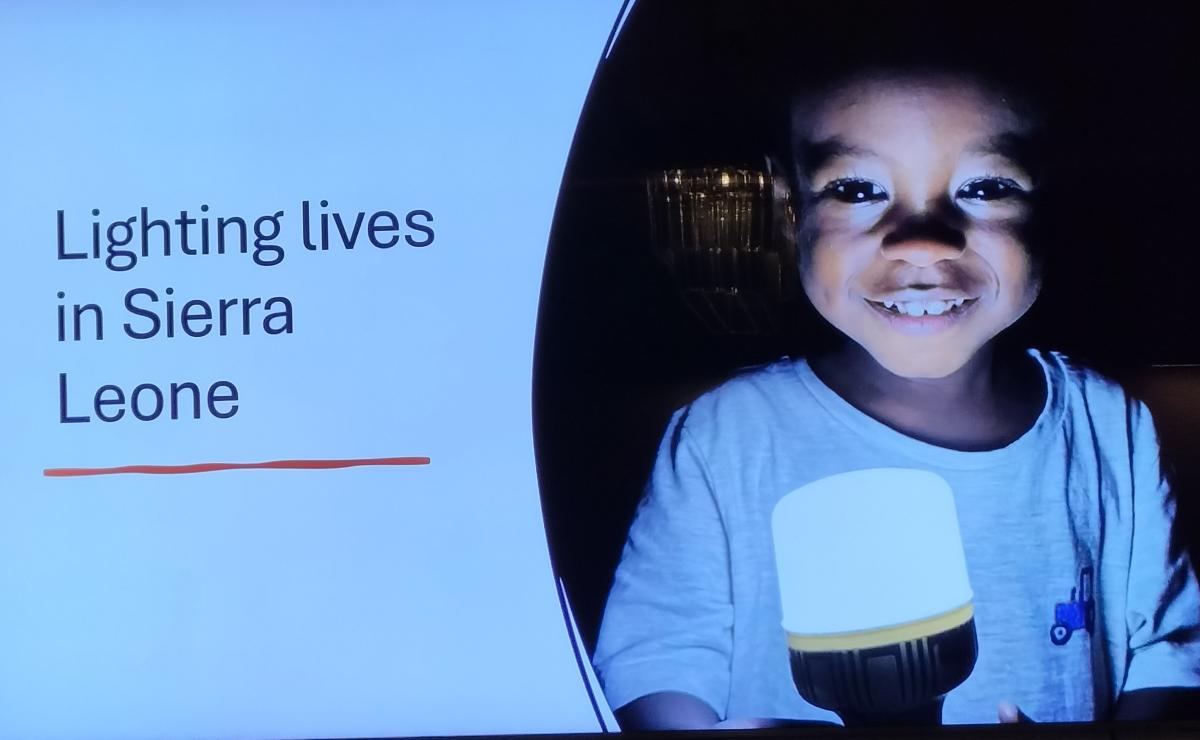
Transform Salone: Lighting up Lives in Sierra Leone
President Jim introduced us to Helen Clayton who lives in Bexley and is a practicing GP. She is daughter of John Clayton, a well-known Dover Rotarian. Jim referred to Helen’s great energy, being a GP, with a family and father to look after, as well as being a Rotarian. She also spends time in Africa each year with the ‘Transform Salone’ charity which operates in Sierra Leone where there is great poverty and poor health and educational facilities.
Helem began by giving us some information about Sierra Leone. It is a small West African country with a population of 8 million people and is one of the world’s poorest nations, and probably the most unhappy country on the planet. It has experienced civil war (1999 – 2001), an Ebola outbreak in 2014, recent mud slides and flooding, high inflation, and a President and his wife who show little concern for their people. In 2024 the Government declared a national emergency because of the rapid increase in the use of a synthetic cannabis type drug called ‘Kush’ which first appeared in 2021 and has caused many deaths, especially of younger people. This has contributed to a life expectancy of only 55 years.
Sierra Leone is also the worst place to be for a girl or woman. Infant and maternal mortality rates are among the highest in the world, healthcare is variable and there is a lack of doctors. Only half of the children born survive beyond the age of 5. Helen knew a woman who had a healthy child: he was the only survivor of her 9 children. The majority of the population live in food insecurity and there is widespread malnutrition.
Education is meant to be free but families have to buy uniforms, books and equipment. There is also malpractice among school staff. The poor standard of education results in only 46% of adults being able to read.
However, despite all its problems, Sierra Leone is a beautiful country with stunning views in the mountains and down to the sea. It is also rich in natural resources such as diamonds, gold, bauxite and aluminium.
Since 2014 ‘Transform Salome’ has sponsored many children through education, has donated food to families in crisis, and provided emergency medical care. It has also given schools hand washing facilities, thousands of pencils and other stationery.
Helen gave us the example of Magu, a 12 year old child sponsored by the charity. At the age of seven he was sent to Freetown to live with a relative who was deaf and dumb who was meant to look after him. She made a living by running a shop selling drinks, alcohol and cannabis. Magu missed his family and had to help the relation with communication. After school he had to run the shop and sell drinks in the street. He is now in year 5 at school as he missed so much time, but sponsorship from ‘Transform Salone’ provided money which enabled him to attend school regularly. This encouraged him and he has made good progress. He is now in the top ten pupils for each school subject out of a class of 40.
To mark ten years since starting to help Sierra Leone, ‘Transform Salone’ decided to work with community leaders to provide solar lighting in some of the villages in the provinces. The ‘Light Up Saone Project’ is a great benefit to the villages involved. None of them has electricity so days end at sundown (7pm). Solar lighting will enable children to study and complete homework, allow trading to continue, encourage community activities and contribute to the safety of women and children after dark. The solar lights, made in China, are sustainable with a battery and solar light on each pole. People from the community take responsibility for looking after them. The aim of the project is to raise 30,000 dollars.
Helen then gave us an idea of the medical outreach that she is involved in each year. We saw a brief video of ‘Salone 2024 Mission Trip’, to a village where solar lights have been put up. Here Helen and other volunteers have to camp in tents which have been checked for snakes, but not spiders. The waiting room for treatment is colourful and overflowing with people. Medical help is given for many different conditions and illnesses, and medication prescribed where appropriate, with instructions how to use it. All patients are given a toothbrush and toothpaste to take home.
Helen referred to her first involvement in medical outreach 10 years ago. There was a consignment of medication from the US, and 15,000 people were seen in four days: antibiotics, antimalarials and painkillers were the main medications. Currently, Helen is working on education for treating chronic diseases in Sierra Leone, such as hypertension and diabetes.
Helen’s trips to Sierra Leone are self-financed at £8,500 a year. Although it is a poor country it is not cheap to live there. After her trips to Sierra Leone she is getting to know the people and their culture well, including language and cooking. In Freetown she has a place where she stays and reads to local children and has seen considerable improvement. She has also been invited into local homes and was given a present on her birthday, signs of how she is much appreciated.
In conclusion, Helen’s presentation about one of the poorest countries in the world made us feel how fortunate we are to live in the UK. Compared with the people of Sierra Leone we have nothing to complain of.
'What We Do' Main Pages:
March/April Newsletter for 2026
more