Dean Scoggins: Sports Editor for the Sun Newspaper
Mon, Oct 5th 2026 at 4:12 pm- Thu, Dec 31st 2026 - 6:12 pm
Dean grew up in Dover and was always keen on sport, especially football. He gave an account of his progress from school up to becoming Sports Editor of the Sun, as well as an insight into the profession of Journalism in a National Newspaper.
Dean Scoggins: Sports Editor for the Sun Newspaper
Introduction
President Jim began by welcoming guests: his son Richard, whose wife Barbara came later, his wife Nannette, as well as Dean and his mother Sally. Dean and Richard both went to Dover Boys’ Grammar School 31 years ago and played football together. Dean’s mother was a keen sportswoman and a training partner with Jim in their younger days when they completed marathons in many different cities. When Sally and family moved to Deal and Jim took on Cullins Yard this ended their training. About 25 years ago Sally did her nursing training and one of her placements was in community nursing, where she first met Sue Prebble. They were delighted to meet up again after all those years.
Jim referred to Dean’s determination; when faced with a challenge he always wanted to come out on top. An early example was from when Dean was a 14 year old out with family and friends at an Indian restaurant. He decided to order ‘Bangalore fire’, a really hot curry and said it would be no problem. He managed to eat it all but sweated profusely afterwards. This quality of determination was to be an asset to his career development in journalism.
Dean then gave his extremely interesting and knowledgeable talk about journalism without any notes and then dealt fluently and logically with questions that resulted in considerable discussion.
Dean said it was lovely to be back in Dover and gave us an idea of how he began his career in journalism. He played football for Dover Athletic but knew that he was not good enough to become a professional so journalism was a way of being involved with sport. Work experience at Dover Athletic, such as creating club programmes with his friend Richard, writing press reports and carrying out interviews, was valuable for developing skills. If he said yes to a challenge he would always back this up with the determination to do what was necessary to finish the job. He found that studying for a university degree was rather tedious, so became involved in several radio stations which gave him more useful experience.
The Sun Newspaper was the first national to run a graduate training scheme as it was clear that local papers were on the wane and did not necessarily provide a route into National Dailies. The training lasted nine months for a group of ‘Super 6’ graduates from the many who applied. Dean was 7th so when one of the 6 dropped out he took their place. All 6 were hired and Dean went into sport and became a sub-editor. When the rugby correspondent became ill Dean said he would take on the job even though it was not his sport. As rugby correspondent he covered the Six Nations and then an infamous tour to Australia, which was quite an experience.
His next move was to become the Midlands football correspondent. His first day in the job corresponded with the 1998 World Cup Final in Paris, remembered for Zidan Zidane headbutting an opponent. In this role Dean came to know football manager Martin O’Neill well, covered two cup finals and did an interview with David Beckham. It was while he was in the Midlands that he met his wife. He then had another spell as a sub-editor.
Dean liked to make up puns for different footballers and wrote them down, and was always thinking up catchy headlines. By the age of 30 he was the youngest ever sports editor for the Sun. He would often stay awake until he had seen other papers’ back page stories: if he had missed anything and could make improvements, then changes would be made for the second edition.
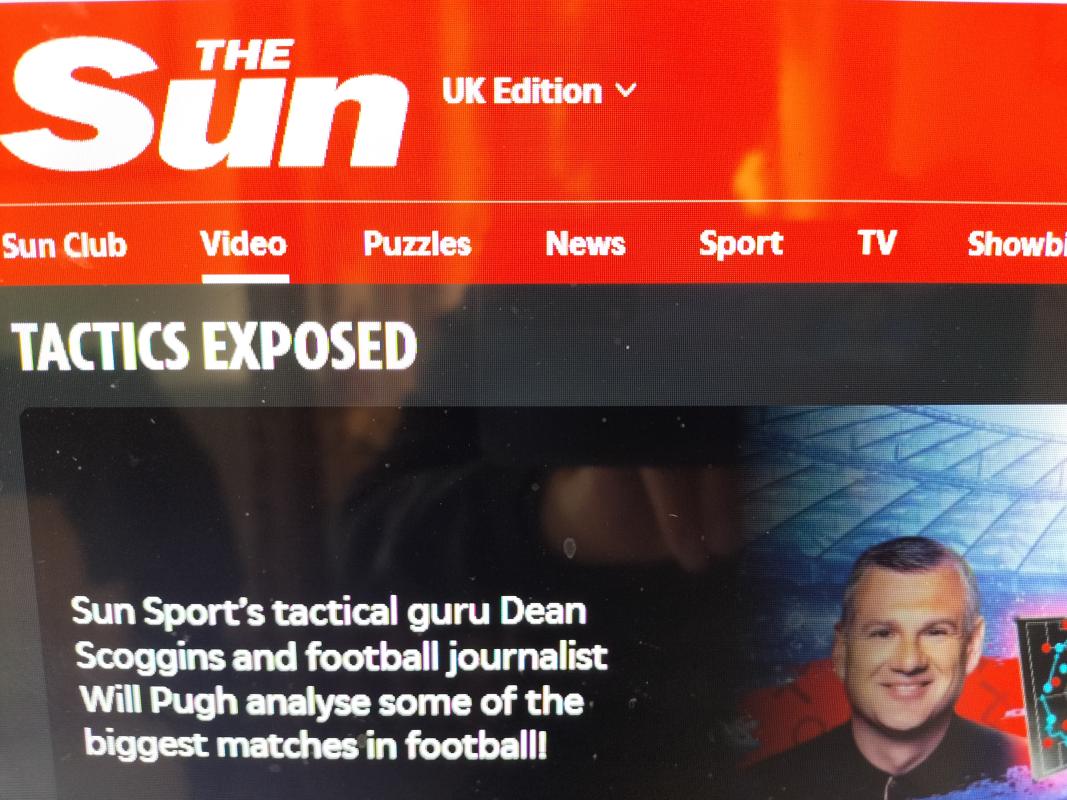
He is now at the forefront of more recent technologies, particularly digital and social media. He became a specialist in football tactics and has produced 185 editions of ‘Tactics Exposed’ with 80 million views. He is known as the Sun’s ‘tactical Guru’. He went to the World Cup this year and reported daily from there, ready for morning editions. He appears on Toc Toc (Tactics on tic toc), and Instagram with millions of followers. Despite the digital transformation he talks to audiences and engages them, creating digital communities.
Looking to the future Dean believes that in the next five years AI will bring one of the biggest transformations since the invention of the printing press and then the internet. We know that AI can be wrong: inaccurate, libelous and create deep fake, which is worrying. AI can’t experience the pride in getting a story right which journalists can experience. It can’t hold individuals such as politicians or the rich and powerful in large organisations to account. It can’t regulate itself. It lacks the nuances that come with being human based on morality and emotions. However, it is an opportunity for journalists.
Dean doesn’t buy in to the dystopian view of the future of AI. He believes in human contact and that technology is just a tool. For example, AI would take 15 seconds to check through all the document relating to the Manchester City case. It is a tool that can uncover wrongs and ask questions. Dean wants to see a future for journalists where they can be trusted and will mobilise to develop communities, not so much through local papers as in the past, but in the digital world.
Dean then took questions which led to some interesting discussion. First was the problem with Manchester City’s alleged wrongdoing. They have done a lot wrong and a judgement on this was made four years ago but only made public recently. The independent panel of three judges found the club’s owners guilty on 114 occasions of ‘cooking the books’ and inflating the value of their spending ability by £930 million over 10 years. The club had to appeal against its charges by 3rd of October and no doubt will hire expensive lawyers to find arguments that justify their wrongdoing. The Premier League wants the case to be concluded by the end of the current football season.
Dean referred to Karen (now Lady) Brady who writes a column for the Sun and believes that Manchester City should have 25 points deducted for each of the next 10 seasons. Unfortunately, it will not be the owners and players who will suffer most if the club is found guilty, but the ordinary people involved in running the club working in such areas as administration, hospitality and maintenance, as well as the fans.
As mentioned above, AI was discussed which is worrying development because of the speed of its development and potential to be misused.
Dean was thanked for an extremely interesting talk which demonstrated his extensive achievement and knowledge of working as a journalist for a national newspaper. It gave an insight into the workings of the profession as well as its values. Dean attends regular editorial meetings and is able to give his opinions on different stories, apart from sport, concerning their public interest.
'What We Do' Main Pages:


March/April Newsletter for 2026
more