Talk on Rev Charles Doudney, Padre for a Somerset Regiment
Thu, Mar 5th 2026 at 7:00 pm - 9:00 pm
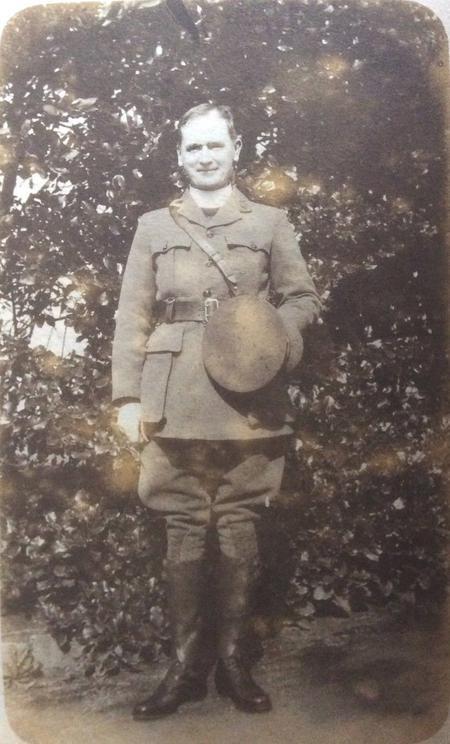
Guest speaker, Julian Humphries, will speak to members about the experiences of Rev Charles Doudney who was a Padre to a Somerset Regiment during the first world war.
Club members please log in for more information.
Julian Humphries came to the Club to talk about the life of the Revd. Charles Doudney. After a successful career in accountancy, Julian has returned in retirement to his first love – history. This has led to unexpected finds in second-hand bookshops, including a biography of a young man who was a vicar at St Luke’s in Bloomfield, Bath, early in the last century.
Charles Doudney was born in Carlisle in 1871, the middle one of seven children. In 1880 the family moved south to Hastings, and the young Charles was educated at Hastings Grammar School. From here, he gained a place at Corpus Christi College Cambridge and on graduating, at Ridley Hall Theology College. He became a deacon in 1894, and a year later, was ordained as an Anglican priest.
For a short time he was a curate in Penge, London and during this time he met 19 year old Joanna (always known as Zoe) Poulden.
Charles decided he was not cut out for parish work and following the advice of his charismatic tutor at Cambridge, Dr Harmer, he volunteered to help with missionary work in the Australian outback.
 While in Australia there followed a lengthy correspondence with Zoe’s father who after two years, finally agreed to let them marry. The young couple returned to Australia after their wedding, but his bride found the heat oppressive and they came back to England and settled in Hampstead. By this time they had two daughters, but sadly the younger one caught pneumonia and died. After this tragedy, the family moved to Bath and settled into the rectory at St Luke’s. Charles, then 36, set about invigorating the Parish – he put on more services, hosted more events at the vicarage, started some new clubs and reinvigorated the existing ones, as well as expanding the church and putting in electricity to the vicarage. They had two more daughters and at the same time, Charles was very involved in sports – he played tennis, golf and cricket, and was also a very good shot, competing at Bisley.

 As a break, in 1914, Charles organised a five-week chaplaincy in Switzerland, at a place called Terasp, near the border with Austria. The timing couldn’t have been worse. On 28 June, the Archduke Ferdinand had been assassinated in Sarajevo. The consequences of this act were still playing out when Charles and Zoe left England on 26 July for Switzerland. He arrived on 3 August – the day before war was declared. It was difficult to get any information on what was going on anywhere in Europe and in Switzerland, there was no information coming out of England, but on 23 August Charles set off home anyway with no idea what he might find. The plan was to travel via Paris, Amiens and Boulogne. It was disconcerting at first to see so many trains full of soldiers travelling the other way, towards the front, but it soon seemed almost normal. More alarming was that Boulogne seemed to be full of Belgian refugees trying desperately to escape to Great Britain.
Once he was safely back in Bath, Charles became very active with the Committee for Refugees. But with a war on, he did not feel that he could stay at home for long when so many families were making sacrifices. He was recruited by Bishop Taylor-Smith, the Chaplain General, to be an Army Chaplain, and was posted to the No 8 Base Hospital in Rouen at short notice.
There was no training offered or available, and the duties of the post were unclear, with the exception of Church Parade which had to take place every Sunday. Otherwise, it gradually became apparent, the Chaplain “….is encouraged, nay expected to take on any job which is not specifically somebody else’s.” Charles gradually established a routine. In the mornings, he rode in the forest a lot – to keep fit and also for his sanity. Then would follow a stint of letter censoring, followed by a session helping in the X-ray department (this in the context of the huge numbers of casualties incurred at nearby Ypres). Evenings were spent in the officers’ mess.
 After six weeks in Rouen, Charles was posted to the front to join the 6th Division. He was told to report to the 18th Infantry Brigade but couldn’t find anyone who knew where that was. Eventually he found himself attached to the 2nd Battalion DLI and 18th Field Ambulance. He was based at the ADS at the Hop Store, Vlamertinghe. He wrote “The ambulance is in a brewery among bales of ancient hops, rather sour and the smell will, to my dying day, remind me of those scenes of blood.” Here, he was one of five chaplains, one of whom was Neville Talbot. They had preliminary discussions about setting up a Church Club but until that happened, most of their work was on Sundays, conducting services for small groups of men scattered around the area. The services they conducted were inter-denominational. The chaplains hoped that the German chaplains would cater for the spiritual needs of any wounded British, Empire or French prisoners of war. There were of course burials to be conducted as well. Some of these were done at night, as that was the safest time of day.
 On a lighter note, a piano was acquired (not too many questions asked) and the chaplaincy started to hold concerts which the men enjoyed very much.
 In July, Charles was given two weeks sick leave to go home – this passed all too quickly and then he was back in Belgium, joining his Division which was on a mission to retake Hooge, in Belgium. This meant that everyone available was pressed into tending to the wounded, working three shifts a day, morning, afternoon and evening. After just a few hours sleep, the work carried on, day after day. There were not enough doctors for the numbers of wounded, as the rest were up at the front.
Given the pressures of this work, it is perhaps not surprising that the October edition of the St Luke’s Parish Magazine should note that ‘there is no letter from the Vicar this month.’ The Parish hoped however that he would somehow be able to return for the Patronal Festival on 17 October, as it was known that he was owed several days leave.
 He was indeed awarded five days of leave, and he hoped to set off for home on Wednesday 13 October – however he did have to travel to the trenches before leaving to bury eight men. Being driven through Ypres he was struck by a shell fragment which penetrated his bowel. He was operated on by the Surgeon General in the Thursday evening, and visited by his friend Neville Talbot the next morning. But this was before antibiotics were in general use, so when infection set in, there was little hope and Charles died the next day, aged only 44.
His family received over 200 letters of condolence and his commanding officer wrote “his whole heart was in his work and he would give himself no rest.” He was buried in the little cemetery attached to the No 10 Casualty Clearing Station and a plaque to his memory was put up in St Luke’s Church where it can still be seen.
'What We Do' Main Pages:

Precious Sisters keeps in touch with the supporters and students during the pandemic and school closures
more

The Bathavon Rotary Club newsletter 'Roundabout' provides reports on recent activities and lists upcoming meetings and events.
more
.jpeg)

Bathavon club member Keith has been to Sri Lanka supporting Tea Leaf Vision in their education initiatives, particularly helping English language teachers
more